 Skip to content
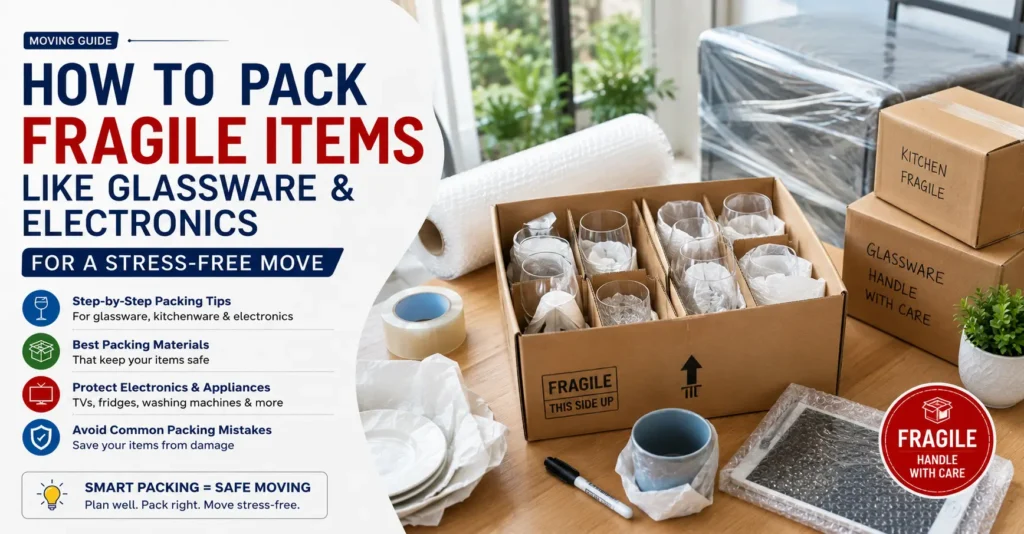
How to pack fragile items for moving is the one question almost every household asks a few days before shifting day, usually right after opening a kitchen cabinet and realising just how much glassware and old electronics has piled up over the years. If you have ever unpacked a box at your new home only to find a shattered photo frame or a cracked wine glass, you already know why this step deserves more attention than it usually gets. The good news is that packing breakables safely is not complicated once you understand the logic behind it: cushioning, spacing, and the right box for the right item.
This guide covers delicate kitchenware first, then large home appliances like TVs, refrigerators, and washing machines, plus why professional-grade materials outperform newspaper and cheap cartons. Whether you plan to pack everything yourself or bring in help for the heavy lifting, it will help you make smarter decisions at every stage.
Table of Contents
- Why Packing Fragile Items Correctly Matters
- Packing Materials You Will Need Before You Start
- The Bubble-Wrap and Double-Box Method for Glassware
- Packing Delicate Kitchenware Item by Item
- Step-by-Step for TVs, Fridges, and Washing Machines
- Why Quality Packing Materials Make the Difference
- Common Mistakes That Damage Fragile Items During a Move
- DIY Packing vs Hiring Professional Movers
- Frequently Asked Questions
- Final Thoughts
Why Packing Fragile Items Correctly Matters
Every mover has a story about the one box that did not survive the trip. It is almost never the furniture that breaks. It is the glass jar at the back of the cupboard, the framed wedding photo, or the blender nobody thought twice about. Getting this step right protects things that are often expensive, sentimental, or simply a hassle to replace on short notice in a new city.
There is also a cost angle people underestimate. Replacing a cracked TV screen or a full crockery set costs far more than the bubble wrap and sturdy boxes needed to prevent it. Insurance can help with big-ticket electronics, but it rarely covers everyday glassware, and claims take time to process. Getting the packing right the first time saves both money and the frustration of starting a new home with broken belongings.
Movement inside a box is the real enemy here, not the drive itself. Trucks brake, turn corners, and go over speed bumps, and every one of those moments sends a small jolt through anything that is not held firmly in place. Once you understand that packing is really about eliminating internal movement, the rest of this guide will make a lot more sense.
Packing Materials You Will Need Before You Start
Before we get into how to pack fragile items for moving room by room, it helps to gather the right supplies first. Trying to improvise halfway through packing a kitchen almost always ends with someone using a bedsheet to wrap a mirror, which is not ideal.
- Double-walled corrugated boxes in small and medium sizes (large boxes tempt you to overload them)
- Bubble wrap, ideally small-bubble for individual items and large-bubble for bigger surfaces
- Packing paper (plain newsprint without ink, not old newspaper)
- Foam sheets or foam corner protectors for edges and corners
- Cardboard dividers for glasses, stemware, and plates
- Stretch wrap for furniture and upholstered items
- Strong packing tape and a tape gun
- Permanent markers for labelling “Fragile” and “This Side Up”
- Scissors or a box cutter
Having these on hand before you start means you will not be tempted to cut corners with whatever is lying around the house, which is where most packing damage actually begins.
The Bubble-Wrap and Double-Box Method for Glassware
If there is one skill worth learning to pack glassware for moving without breakage, it is this technique that every professional packer relies on. The idea is simple: wrap the individual item, place it inside a smaller “inner” box with cushioning on all sides, then place that inner box inside a slightly larger “outer” box with another layer of cushioning between the two. This creates two independent shock-absorbing layers instead of one, so even a hard knock rarely reaches the item itself.
Here is how to apply it, step by step:
- Wrap each item individually. Never wrap two glasses or plates together thinking it saves time. Lay the item on a sheet of packing paper first to cover sharp edges, then wrap it fully in bubble wrap, bubble-side facing the item, and secure it with tape.
- Line the inner box. Add a two-to-three-inch layer of crumpled packing paper or foam at the bottom of a small or medium box.
- Place wrapped items with dividers. Use cardboard dividers for glasses and stemware so no two items touch directly. Fill every gap with crumpled paper until nothing shifts when you gently shake the box.
- Seal and label the inner box. Close it, tape it well, and mark it “Fragile.”
- Place the inner box into a larger outer box, leaving at least two inches of space around it on all sides.
- Fill the gap with cushioning. Bubble wrap, foam, or crumpled paper should completely surround the inner box before you close the outer one.
- Seal, label, and mark orientation. Write “Fragile” and “This Side Up” clearly on at least two sides of the outer box.
This double-layer method is exactly why trained teams rarely see breakage on delicate kitchenware, and it works just as well for anyone packing their own boxes at home.
Packing Delicate Kitchenware Item by Item
Not every fragile item behaves the same way, so it helps to know the small adjustments that matter for each type of kitchenware.
Plates and Bowls
Pack plates vertically, on their edge, rather than flat and stacked. Plates packed flat absorb pressure across their widest, weakest point, while plates on edge distribute pressure along the rim, which is far stronger. Wrap each plate individually and place them in a row inside a dish-pack box with dividers.
Glasses and Stemware
Stuff the inside of each glass loosely with packing paper before wrapping the outside; this prevents the glass from collapsing inward under pressure. For wine glasses, wrap the stem first with a small extra layer of padding, since it is the thinnest and most breakable part.
Mugs and Cups
Wrap the handle separately with an extra strip of bubble wrap before wrapping the whole mug, since handles snap off far more often than the body cracks.
Vases, Jars, and Decorative Items
Fill hollow spaces with paper, then wrap the outside twice if the item is unusually shaped or has thin walls. Odd shapes need extra padding at the corners and narrow points, since these are the first spots to crack under pressure.
Mirrors, Photo Frames, and Artwork
Use a mirror box if you have one, or sandwich the item between two pieces of flat cardboard with bubble wrap in between, then tape an “X” across any glass surface to reduce the spread of cracks if it does break.
Step-by-Step: How to Pack Electronics for Moving, Plus Fridges and Washing Machines
Large home appliances bring a different kind of risk. They are not just fragile, they are also heavy, powered by electricity, and often contain moving internal parts that need to be secured before transport. Here is how to prepare the three that cause the most damage claims during a house move.
How to Pack a Television
- Unplug the TV at least an hour before packing so internal components cool down.
- If you still have the original box, use it; it is engineered specifically for that model’s weight and screen size.
- If not, wrap the screen first in a layer of bubble wrap, keeping the TV upright rather than flat, since panels can develop pressure spots if laid down for long periods.
- Add corner protectors on all four corners, then wrap the whole unit in a moving blanket.
- Place it in a snug box or a specialised TV box, and always transport it standing upright, never lying flat.
Disconnecting and Packing a Refrigerator
- Empty and defrost the refrigerator at least 24 hours before moving day to avoid water damage and odour buildup.
- Unplug it and let it dry out fully with the doors open.
- Remove and separately wrap any glass shelves, drawers, and trays; these are the most fragile parts and often travel better outside the unit.
- Tape the doors shut with painter’s tape, not directly on the surface with strong tape, which can leave marks.
- Secure the power cord with tape so it does not drag or catch on anything.
- Keep the refrigerator upright throughout the move; laying it on its side can cause compressor oil to enter the cooling lines and lead to malfunction.
Disconnecting and Packing a Washing Machine
- Disconnect the water inlet and drain hoses, and drain any remaining water completely.
- Fit transit bolts if your machine came with them; these lock the drum in place and prevent internal damage. If you no longer have the originals, ask your packing team about temporary drum-locking alternatives.
- Wrap the hoses separately and tape them to the back of the machine so they do not swing loose.
- Cover the machine with a moving blanket or thick padding, securing it with stretch wrap.
- Keep the machine upright at all times during loading and transport.
Appliances are one area where an extra pair of trained hands genuinely earns its cost, since a mistake here can mean a repair bill rather than just a scratch on a box.
Why the Best Packing Materials for Moving Make the Difference
It is tempting to save money by wrapping fragile items in old newspaper and packing them into whatever free cartons you can find nearby. Unfortunately, this is exactly where most preventable breakage happens.
Newspaper ink can smudge onto glassware and porcelain, and more importantly, it does not cushion nearly as well as bubble wrap because it does not trap air the same way. A worn cardboard carton that has already carried fruit or groceries has usually lost much of its structural strength, meaning it can buckle under the weight of stacked boxes in a truck.
The best packing materials for moving solve these problems directly:
- 5-ply double-wall boxes hold their shape under weight and resist crushing far better than single-wall cartons.
- Anti-static bubble wrap protects electronics from both physical shock and static discharge, which ordinary bubble wrap does not.
- Foam corner protectors absorb impact at the exact points where furniture and appliances are most likely to get dented.
- New, unused cartons have full structural integrity, unlike recycled boxes that have already been compressed once.
This is really the difference between packing that survives a short trip across town and packing that survives being stacked, tilted, and jostled for hours in a truck. If you are hiring help for the heavy lifting, always ask your packers and movers in Bangalore what grade of materials they use before the move, not after something arrives broken.
Common Mistakes That Damage Fragile Items During a Move
Even careful packers repeat a handful of avoidable mistakes. Watch out for these:
- Overpacking large boxes. A big box filled with heavy items is hard to lift safely and puts enormous pressure on whatever sits at the bottom.
- Leaving empty space. Any gap inside a box is room for items to shift, and shifting is what causes cracks, not the initial packing itself.
- Skipping the “This Side Up” label. Boxes that get tipped or laid flat during loading are a common cause of breakage that has nothing to do with the packing quality inside.
- Stacking fragile boxes under heavy ones. Even a well-packed box can buckle if three cartons of books are stacked on top of it.
- Reusing tired boxes. A carton that has already made one move has already lost some of its strength.
- Forgetting to secure appliance parts internally. Loose drums, shelves, or trays can cause damage from the inside, where no amount of external padding will help.
DIY Packing vs Hiring Professional Packers and Movers in Bangalore
Many people start packing on their own and quickly realise that fragile items, in particular, take far longer than expected. A single kitchen cabinet of glassware, wrapped and boxed properly using the double-box method above, can easily take an hour or two. Multiply that across an entire kitchen, a display cabinet, and a home office full of electronics, and the time adds up fast, especially alongside everything else a move demands.
DIY packing works reasonably well for small households with modest fragile inventories and enough lead time before the move. It falls short when large appliances, valuable or antique items, or a tight timeline are involved. This is where household shifting services in Bangalore tend to make the most sense, since a trained team already has the materials, the technique, and the experience of having packed hundreds of similar homes before.

If your move includes a mix of fragile kitchenware and heavier appliances, it is worth getting a quote for office shifting services too if you are relocating a workspace alongside your home, since office moves often involve similarly delicate equipment like monitors and printers that benefit from the same principles covered here.
Frequently Asked Questions
What is the best way to pack fragile items for moving on a tight budget?
Focus your budget on bubble wrap and sturdy double-wall boxes for the most fragile and valuable items first, and use packing paper and towels as filler for the rest. Spending a little more on materials for glassware and electronics prevents the larger cost of replacing broken items later.
Should I use newspaper to pack glassware?
Plain packing paper is a better choice than printed newspaper, since newspaper ink can transfer onto glass, ceramics, and light-coloured items, and it offers less cushioning than proper packing paper or bubble wrap.
How long does it take to pack a full kitchen of fragile items?
For an average household, packing a full kitchen of glassware and crockery properly using the double-box method typically takes four to six hours when done carefully by one or two people.
Do I need to empty my refrigerator before a move?
Yes. Refrigerators should be emptied and defrosted at least 24 hours in advance, dried out completely, and unplugged well before loading to avoid water leakage and odour problems during transit.
Is it worth hiring professionals just for fragile items?
If you have a large volume of glassware, electronics, or valuable items and limited time, hiring help for packing alone, even if you handle the rest of the move yourself, is often worth the cost, since it significantly reduces the risk of breakage.
Final Thoughts
Knowing how to pack fragile items for moving comes down to a few repeatable habits: wrap items individually, eliminate empty space, use the double-box method for anything genuinely delicate, and treat large appliances with the same care you would give a glass vase. Newspaper and recycled cartons might look like a way to save money, but quality materials consistently prevent the kind of damage that ends up costing far more to fix or replace.
If packing an entire home on your own feels like more than you want to take on, Union Packers and Movers Bangalore has been handling exactly this kind of careful, detail-heavy packing since 2005, with trained teams and premium materials for glassware, electronics, and every major home appliance. Whether you need help with just your kitchen or a complete packers and movers Bangalore service for your whole home, getting a quote before moving day gives you one less thing to worry about.
For more general guidance on secure packaging standards, you can also refer to this overview of packaging and labelling practices, and to the Indian Banks’ Association site, whose approval standards are one of the credentials worth checking when choosing a moving company.
